DialogOS is a graphical programming environment to design computer system which can converse through voice with the user. Dialogs are clicked together in a Flowchart. DialogOS includes bindings to control Lego Mindstorms robots by voice and has bindings to SQL databases, as well as a generic plugin architecture to integrate with other types of backends. DialogOS is used in computer science courses in schools and universities to teach programming and to introduce beginners in the basic principles of human/computer interaction and dialog design. It has also been used in research systems. DialogOS was initially developed commercially by CLT Sprachtechnologie GmbH until its liquidation in 2017. The rights were then acquired by Saarland University and the software was released as open-source. == Bindings to Lego Mindstorms NXT == DialogOS can control the LEGO Mindstorms NXT Series. It uses sensor-nodes to obtain values for the following sensors: noise sensor ultrasonic sensor touch sensor luminosity sensor
Apprenticeship learning
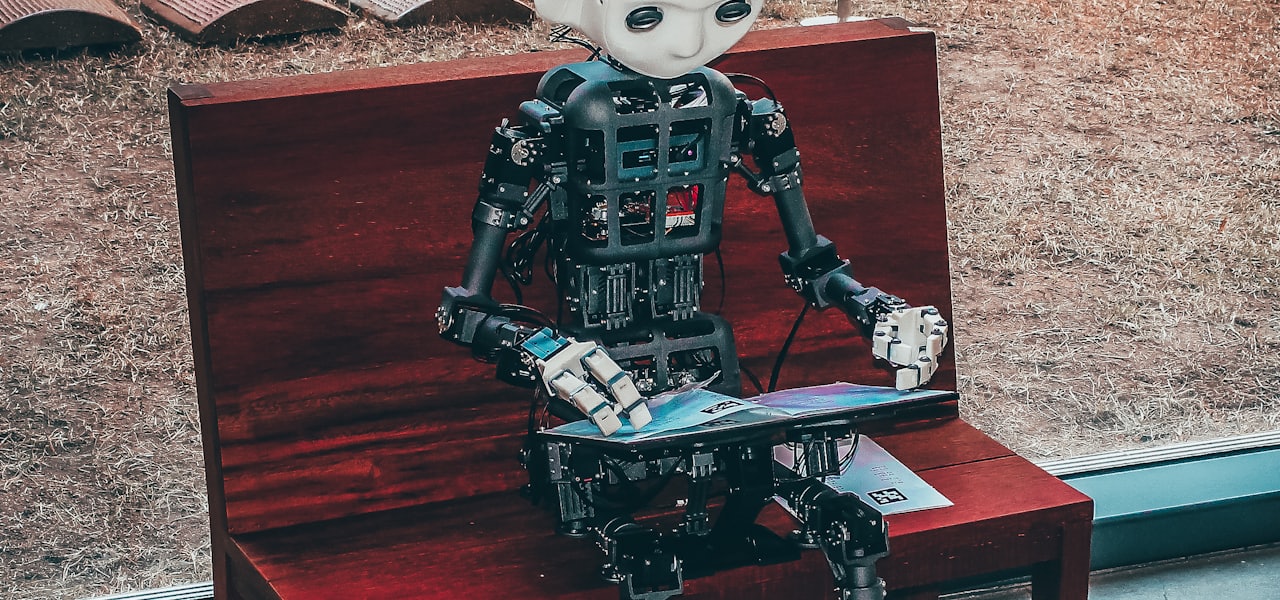
In artificial intelligence, apprenticeship learning (or learning from demonstration or imitation learning) is the process of learning by observing an expert. It can be viewed as a form of supervised learning, where the training dataset consists of task executions by a demonstration teacher. == Mapping function approach == Mapping methods try to mimic the expert by forming a direct mapping either from states to actions, or from states to reward values. For example, in 2002 researchers used such an approach to teach an AIBO robot basic soccer skills. === Inverse reinforcement learning approach === Inverse reinforcement learning (IRL) is the process of deriving a reward function from observed behavior. While ordinary "reinforcement learning" involves using rewards and punishments to learn behavior, in IRL the direction is reversed, and a robot observes a person's behavior to figure out what goal that behavior seems to be trying to achieve. The IRL problem can be defined as: Given 1) measurements of an agent's behaviour over time, in a variety of circumstances; 2) measurements of the sensory inputs to that agent; 3) a model of the physical environment (including the agent's body): Determine the reward function that the agent is optimizing. IRL researcher Stuart J. Russell proposes that IRL might be used to observe humans and attempt to codify their complex "ethical values", in an effort to create "ethical robots" that might someday know "not to cook your cat" without needing to be explicitly told. The scenario can be modeled as a "cooperative inverse reinforcement learning game", where a "person" player and a "robot" player cooperate to secure the person's implicit goals, despite these goals not being explicitly known by either the person nor the robot. In 2017, OpenAI and DeepMind applied deep learning to the cooperative inverse reinforcement learning in simple domains such as Atari games and straightforward robot tasks such as backflips. The human role was limited to answering queries from the robot as to which of two different actions were preferred. The researchers found evidence that the techniques may be economically scalable to modern systems. Apprenticeship via inverse reinforcement learning (AIRP) was developed by in 2004 Pieter Abbeel, Professor in Berkeley's EECS department, and Andrew Ng, Associate Professor in Stanford University's Computer Science Department. AIRP deals with "Markov decision process where we are not explicitly given a reward function, but where instead we can observe an expert demonstrating the task that we want to learn to perform". AIRP has been used to model reward functions of highly dynamic scenarios where there is no obvious reward function intuitively. Take the task of driving for example, there are many different objectives working simultaneously - such as maintaining safe following distance, a good speed, not changing lanes too often, etc. This task, may seem easy at first glance, but a trivial reward function may not converge to the policy wanted. One domain where AIRP has been used extensively is helicopter control. While simple trajectories can be intuitively derived, complicated tasks like aerobatics for shows has been successful. These include aerobatic maneuvers like - in-place flips, in-place rolls, loops, hurricanes and even auto-rotation landings. This work was developed by Pieter Abbeel, Adam Coates, and Andrew Ng - "Autonomous Helicopter Aerobatics through Apprenticeship Learning" === System model approach === System models try to mimic the expert by modeling world dynamics. == Plan approach == The system learns rules to associate preconditions and postconditions with each action. In one 1994 demonstration, a humanoid learns a generalized plan from only two demonstrations of a repetitive ball collection task. == Example == Learning from demonstration is often explained from a perspective that the working Robot-control-system is available and the human-demonstrator is using it. And indeed, if the software works, the Human operator takes the robot-arm, makes a move with it, and the robot will reproduce the action later. For example, he teaches the robot-arm how to put a cup under a coffeemaker and press the start-button. In the replay phase, the robot is imitating this behavior 1:1. But that is not how the system works internally; it is only what the audience can observe. In reality, Learning from demonstration is much more complex. One of the first works on learning by robot apprentices (anthropomorphic robots learning by imitation) was Adrian Stoica's PhD thesis in 1995. In 1997, robotics expert Stefan Schaal was working on the Sarcos robot-arm. The goal was simple: solve the pendulum swingup task. The robot itself can execute a movement, and as a result, the pendulum is moving. The problem is, that it is unclear what actions will result into which movement. It is an Optimal control-problem which can be described with mathematical formulas but is hard to solve. The idea from Schaal was, not to use a Brute-force solver but record the movements of a human-demonstration. The angle of the pendulum is logged over three seconds at the y-axis. This results into a diagram which produces a pattern. In computer animation, the principle is called spline animation. That means, on the x-axis the time is given, for example 0.5 seconds, 1.0 seconds, 1.5 seconds, while on the y-axis is the variable given. In most cases it's the position of an object. In the inverted pendulum it is the angle. The overall task consists of two parts: recording the angle over time and reproducing the recorded motion. The reproducing step is surprisingly simple. As an input we know, in which time step which angle the pendulum must have. Bringing the system to a state is called “Tracking control” or PID control. That means, we have a trajectory over time, and must find control actions to map the system to this trajectory. Other authors call the principle “steering behavior”, because the aim is to bring a robot to a given line.
Digital fashion
Digital fashion is a field of fashion design that relies on 3D software or artificial intelligence to produce hyper-realistic, data-intensive digital 3D garment simulations that are digital-only products or digital models for physical products. Digital garments can be worn and presented in virtual environments, social media, online gaming, virtual reality (VR), and augmented reality (AR) platforms. The field aims to contribute to the development of a more sustainable future for the fashion industry. It has been praised as a possible answer to ethical and creative concerns of traditional fashion by promoting innovation, reducing waste, and encouraging conscious consumption. However, empirical research has questioned whether digital fashion communities embody the radical and anti-consumerist values they claim. A 2025 study presented by YeSeung Lee at the FACTUM international conference on fashion communication analysed 88,141 posts across nine platforms over eight months using Pulsar. It found that only 4.8% of author biographies indicated any sociopolitical focus, and that discourse predominantly relied on generic slogans and trending buzzwords, primarily reinforcing existing fashion hierarchies and consumerist frameworks rather than challenging them. Digital fashion is also the interplay between digital technology and couture. Human AI is an intersection of technology and human representation, in which human value is emphasized and enhanced by technology and the possibilities of discovering design. Information and communication technologies (ICTs) have been deeply integrated both into the fashion industry, as well as within the experience of clients and prospects. Such interplay has happened at three main levels. ICTs are used to design and produce fashion products, while the industry organization also leverages digital technologies. ICTs impact marketing, distribution and sales. ICTs are extensively used in communication activities with all relevant stakeholders and contribute to co-create the fashion world. The fashion industry in general has paved the way for digital fashion to be introduced with more technology being in the industry, like virtual dressing rooms and the gamification of the fashion industry. Digital fashion is also seen on many different online fashion retail websites. This evolution in the fashion industry has called for more education and research of digital fashion. == Design, production, and organization == Among the many applications available to fashion designers to model the fusion of creativity with digital avenues, the Digital Textile Printing can be mentioned here. === Digital textile printing === Digital textile printing has brought together the worlds of fashion, technology, art, chemistry, and printing to produce a new process for printing textiles on clothing. Digital printing is a process in which prints are directly applied to fabrics with a printer, reducing 95% of the use of water, 75% of the use of energy and minimizing textile waste. The main advantage of digital printing is the ability to do very small runs of each design (even less than 1 yard). Digital Textile printing also offers other benefits, such as fast printing speeds that help the time and space needed to print different patterns on garments of choice. == Marketing, distribution, and sales == While all digital channels can be used in order to market and sell fashion completely online (eCommerce), they usually are implemented in connection with offline channels (so-called "omni-channel"). Here, virtual and augmented reality play a crucial role. The fashion industry has faced its own problems including pollution and fabric waste, which has resulted in a shift to more sustainable methods like digital fashion. The industry is also constantly being intertwined with digital media and has allowed for the use of digital tools within the business itself and with consumers. Two of the ways digital fashion is utilized with consumers is through virtual dressing rooms and virtual cosmetic counters. Prospects and clients can use ICTs - own computers, tablets and smartphones - to virtually simulate fitting rooms and cosmetics counters and see how they look in specific outfits and makeup. Customers can give any look and decide on what suits them and buy products. Oftentimes, beauty retailers will feature virtual fitting rooms to allow users to experience the look of their product before committing to a purchase. Some examples are color contact retailers Freshlook, which allows users to simulate contact lens wear in their color contacts studio before purchase. Colorful Eyes also offers a virtual color contact lens try-on room. === Virtual dressing room === A virtual dressing room (also often referred to as virtual fitting room and virtual changing room although they do perform different functions) is the online equivalent of the near-ubiquitous in-store changing room – that is, it enables shoppers to try on clothes to check one or more of size, fit or style, but virtually rather than physically. Fashion retailer Topshop installed a Kinect-powered virtual fitting room at its Moscow store. Created by AR Door, the Augmented Fitting Room system overlays 3D augmented reality clothes on the customer. Simple gestures and on-screen buttons let users "try on" different outfits. However, the high variability of virtual fit platforms to predict consumer clothes sizes called into question the accuracy of these systems in their current form. AI-powered Wardrobe and Outfit Planning Beyond virtual fitting rooms, the integration of artificial intelligence has enabled the rise of digital wardrobe management. These platforms use computer vision and machine learning to catalog a user’s physical or digital garments, providing automated outfit recommendations based on weather, occasion, and personal style trends. Fashion-tech startups utilize AI-driven garment simulation to help users plan outfits virtually, bridging the gap between digital-only fashion and physical wardrobe utility. This "smart closet" approach aims to reduce "wardrobe fatigue" and decrease unnecessary consumption by maximizing the use of existing items through digital visualization. === Communication and experience co-creation === Fashion is also a matter of socially negotiating what is "in" or "out", fashionable or not. In other words, fashion items do not only play on the economic market of physical goods but also - and sometimes even more importantly - on the semiotic market of the production of social tastes and customs. Thanks to social media, and to all services offered by the so-called web2.0, laypeople can contribute to co-create the fashion world, shaping tastes, customs, and fashion-related values. Social media, in general, has catapulted the impact fashion has on our everyday lives and values. Fashion has taken a central role in mass production and is constantly evolving due to the ever-lasting digital transformation. Social media has also helped evolve to a point where not only can brands reach consumers, but consumers can reach brands as well. TikTok for example started a trend in 2020 with #GucciModelChallenge. This creates a space where the brand is gaining awareness from their consumers in the ever-changing digital age. === Gamification === Gaming has played an important role in fostering digital aspects of the fashion world, first beginning with dress-up games that used avatars and allowed players to select garments. Nevertheless, it seems it will now move on to the real world and start using avatars of real people. Garments from luxurious brands have been copied and adapted into the aesthetics of games such as Animal Crossing: New Horizons and The Sims. As to the former, during COVID-19 lock-downs players recreated outfits from a variety of fashion brands, including Chanel, Gucci and Versace. It became a platform for users to showcase their costume designs. In April 2019, Moschino collaborated with simulation game The Sims in a capsule collection that featured signature Jeremy Scott garments. The collection was made available to shop and the campaign was set against the backdrop of a Sims-like atmosphere. Furthermore, in May 2019, Nike partnered up with Fortnite to include their iconic Jordan sneakers. In similar fashion, in May 2020, Marc Jacobs designed 6 of the brand's favorite looks for Nintendo's Animal Crossing: New Horizons in a partnership with Instagram user @AnimalCrossingFashionArchive. They were made available to download. Similarly, the other luxury brands mentioned, Louis Vuitton partnered with game League of Legends to create skins for characters within the game. Digital fashion in different video games allows users to express themselves beyond their avatars and combine the self-expression of fashion into the digital gaming realm. == Digital fashion education and research == Nowadays, the fashion industry needs experts in digital fashion, equipped with the above-ske
Woken Furies
Woken Furies (2005) is a science fiction novel by British writer Richard Morgan. It is the third novel featuring the anti-hero Takeshi Kovacs and is the sequel to Broken Angels. This addition to the series casts light upon Kovacs' early life providing information on his post-envoy activities. Morgan's official website and interviews suggest that Woken Furies could be the last Kovacs novel, although in 2018 (before Netflix cancelled the show) Morgan stated that the Netflix adaptation has "kind of woken it all up again" after all these years, making him possibly reconsider being done with Kovacs. == Plot == Takeshi Kovacs finds himself in a new "sleeve," or human body, back on his home planet of Harlan's World. He is on the run after making numerous attacks against the Knights of the New Revelation, an extremist religious order responsible for the death of his lost love and her daughter. Because she had violated tenets about resleeving, her executioners dropped her and her daughter's cortical stacks in the sea, effectively preventing them from being resleeved (into new bodies). While trying to secure passage after his most recent attack, Kovacs saves a woman named Sylvie from a group of religious zealots. In return, she allows him to take refuge with her mercenary "deCom" crew as they head out to decommission sentient military hardware that has run amok on the island of New Hokkaido (AKA New Hok). Sylvie is the "command head" of her crew, co-ordinating them during missions by using her biologically implanted circuitry and software. During one of these missions, Sylvie collapses, regains consciousness, and Kovacs realizes that her personality seems to have been replaced by that of long-dead revolutionary leader Quellcrist Falconer. Harlan's World is surrounded by automated "orbitals" which target flying objects, such as vehicles, with high-energy beam weapons known as "angelfire"; Falconer is believed to have died without a backup of her cortical stack when her getaway aircraft was destroyed by angelfire 300 years prior. When Sylvie's crew returns from New Hok, they discover a younger version of Kovacs has been illegally duplicated into a different body (AKA "double sleeved") and is hunting them on behalf of the Harlan family that rules the planet. Most of Sylvie's crew is killed and Sylvie/Quellcrist is captured. Kovacs schemes to rescue Sylvie by approaching old criminal associates of his, the Little Blue Bugs. The Little Blue Bugs mount a semi-successful attack on a Harlan fortress and rescue Sylvie/Quellcrist. Hiding from Harlan forces in a floating base, the neo-Quellists are sold out by its owner and recaptured. An assault by Kovacs and a single UN Envoy on the base ends badly when Kovacs is betrayed by the Envoy who was actually embedded with several colleagues. However, Sylvie/Quellcrist has established a connection with the orbitals and calls down angelfire, eliminating their captors. The younger Kovacs is killed in the aftermath. Sylvie explains that angelfire is a destructive recording device. Thus, in destroying Quellcrist and the helicopter carrying her, it copied her. When the technology of the deCom crews advanced far enough, her persona was able to insert itself into Sylvie's implants and co-exist in her body. The novel ends with Kovacs, Virginia Vidaura, and Sylvie/Quellcrist waiting to see if they can use Sylvie/Quellcrist's newfound connection to the orbitals and the expansion of a long-dormant genetic virus to turn the population against the ruling oligarchy.
International Aerial Robotics Competition
The International Aerial Robotics Competition (IARC) is a university-based robotics competition held on the campus of the Georgia Institute of Technology, currently hosted by RoboNation. Since 1991, collegiate teams with the backing of industry and government have fielded autonomous flying robots in an attempt to perform missions requiring robotic behaviors not previously exhibited by a flying machine. The term “aerial robotics” was coined by competition creator Robert Michelson in 1990 to describe a new class of small highly intelligent flying machines. Successive years of competition saw these aerial robots grow from vehicles that could barely maintain themselves in the air, to automatons which are self-stable, self-navigating, and able to interact with their environment. The goal of the competition has been to provide a reason for the state-of-the-art of aerial robotics to move forward. Challenges have been geared towards producing advances. From 1991 through 2009, six missions were proposed. Each involved fully autonomous robotic behavior undemonstrated at the time. In October 2013 a seventh mission was proposed. It was the first to involve interaction between aerial robots and multiple ground robots. In 2016, the competition and its creator were recognized during the Georgia legislative session in the form of a senate resolution as the longest running aerial robotics competition in the world. == History == === First mission === The initial mission to move a metallic disc from one side of an arena to the other was seen by many as almost impossible. The college teams improved their entries over the next two years when the competition saw its first autonomous takeoff, flight, and landing by a team from the Georgia Institute of Technology. In 1995, a team from Stanford University was able to acquire a single disk and move it from one side of the arena to the other in a fully autonomous flight—half. === Second mission === The competition mission was toughened and made less abstract by requiring teams to search for a toxic waste dump, map the location of partially buried randomly oriented toxic waste drums, identify the contents of each drum from the hazard labels on the outside of each drum, and bring a sample back from one of the drums. In 1996, a team from the Massachusetts Institute of Technology and Boston University, with backing from Draper Labs, created a small fully autonomous flying robot that repeatedly and correctly mapped the location of all five of the toxic waste drums, and correctly identified the contents of two from the air, completing approximately seventy five percent of the mission. The following year, an aerial robot developed by a team from Carnegie Mellon University completed the entire mission. === Third mission === The third mission began in 1998. It was a search and rescue mission requiring fully autonomous robots to take off, fly to a disaster area and search amid fires, broken water mains, clouds of toxic gas, and rubble. The scenario was recreated at the U.S. Department of Energy's Hazardous Material Management and Emergency Response (HAMMER) training facility. Because of the realism of the scenario, animatrons were used instead of human actors to simulate survivors incapable of extracting themselves from the disaster area. An aerial robot from Germany's Technische Universität Berlin was able to detect and avoid all of the obstacles, identify all the dead on the ground and the survivors (distinguishing between the two based on movement), and relay pictures of the survivors along with their locations back to first responders who would attempt a rescue. This mission was completed in 2000. === Fourth mission === The fourth mission was initiated in 2001. It involved three scenarios requiring the same autonomous behavior: a hostage rescue mission where a submarine 3 kilometers off the coast must send an aerial robot to find a coastal city, identify the embassy where hostages are being held, locate valid openings in the embassy building, enter (or send in a sensor probe/subvehicle) and relay pictures of the hostages 3 km to the submarine prior to mounting an amphibious assault on the embassy to free the hostages; the discovery of an ancient mausoleum where a virus had killed the archaeological team, who had radioed that an important and undocumented tapestry was hanging inside, with 15 minutes to send an autonomous aerial robot to find the mausoleum, enter it (or send in a sensor probe/subvehicle) and relay pictures of the tapestry back prior to the destruction of the mausoleum and its contents; and an explosion at a nuclear reactor facility where scientists must send in an aerial robot to find the operating reactor building, enter the building (or send in a sensor probe/subvehicle) and relay pictures of the control panels to determine if a melt-down is imminent. All three missions involved the same elements of ingress, locating, identification, entry, and relaying pictures within 15 minutes. It was conducted at the U.S. Army's Fort Benning Soldier Battle Lab using the McKenna MOUT (Military Operations on Urban Terrain) site. The fourth mission was completed in 2008 with 27 teams who had demonstrated each of the required aerial robotic behaviors, except being able to demonstrate these behaviors in under 15 minutes—a feat considered by the judges to be inevitable given more time, and therefore no longer a significant challenge. Thus the fourth mission was terminated, $80,000 in awards distributed, and the fifth mission established. === Fifth mission === The fifth mission picked up where the fourth mission left off by demonstrating the fully autonomous aerial robotic behaviors necessary to rapidly negotiate the confined internal spaces of a structure once it has been penetrated by an air vehicle. The nuclear reactor complex explosion scenario of the fourth mission was used as the backdrop for the fifth mission. The fifth mission required a fully autonomous aerial vehicle to penetrate the structure and negotiate the more complex interior space containing hallways, small rooms, obstacles, and dead ends in order to search for a designated target without the aid of global-positioning navigational aids, and relay pictures back to a monitoring station some distance from the structure. The First Symposium on Indoor Flight Issues was held in conjunction with this 2009 IARC event. === Sixth mission === The sixth mission began in 2010 as an extension of the fifth mission theme of autonomous indoor flight behavior, however it demanded more advanced behaviors than were possible by any aerial robot extant in 2010. This espionage mission involved covertly stealing a flash drive from a particular room in a building and depositing an identical drive to avoid detection of the theft. The 2010 Symposium on Indoor Flight Issues was held concurrently at the University of Puerto Rico - Mayagüez during the 20th anniversary competition. === Seventh mission === The seventh mission began in 2014 demanding more advanced behaviors than were possible by any aerial robot extant in 2014. A single autonomous aerial robot had to herd up to 10 autonomous ground robot targets across one designated end of a 20m x 20m (65.62 feet x 65.62 feet) arena in under 10 minutes. The arena had neither walls for SLAM mapping nor GPS availability. Techniques such as optical flow or optical odometry were possible solutions to navigation within the arena. Collisions with obstacle ground robots ended the run with no score. The autonomous aerial robots interacted with the ground robots in the following way: if an aerial robot touched the ground robot on top, the ground robot would turn clockwise 45°. If the aerial robot blocked its forward motion by landing in front of it, the ground robot would reverse direction. Ground robots that feely escaped the arena, counted against the aerial robot's overall score, so the autonomous aerial robots had to decide which ground robots were in imminent danger of crossing any boundary except the designated one, and redirect them toward the designated boundary.Zhejiang University was the overall winner of Mission 7, of 52 teams from 12 nations entered as competitors. === Eighth mission === In 2018, the 8th mission was announced. Mission 8 focused on non-electronic human-machine interaction for the first time, with four aerial robots assisting humans to complete tasks that one person could not independently accomplish. The gist of mission 8 involved a swarm of autonomous aerial robots working with a human to achieve a task in the presence of hostile "Sentry aerial robots" which were trying to impede the human. In 2018, the inaugural year of mission 8, the American Venue was held on the campus of the Georgia Institute of Technology in Atlanta, Georgia, and the Asia/Pacific Venue was conducted at Beihang University in Beijing China. The following year, Mission 8 was successfully completed in Kunming China at the Yunnan Innovation
Protocol engineering
Protocol engineering is the application of systematic methods to the development of communication protocols. It uses many of the principles of software engineering, but it is specific to the development of distributed systems. == History == When the first experimental and commercial computer networks were developed in the 1970s, the concept of protocols was not yet well developed. These were the first distributed systems. In the context of the newly adopted layered protocol architecture (see OSI model), the definition of the protocol of a specific layer should be such that any entity implementing that specification in one computer would be compatible with any other computer containing an entity implementing the same specification, and their interactions should be such that the desired communication service would be obtained. On the other hand, the protocol specification should be abstract enough to allow different choices for the implementation on different computers. It was recognized that a precise specification of the expected service provided by the given layer was important. It is important for the verification of the protocol, which should demonstrate that the communication service is provided if both protocol entities implement the protocol specification correctly. This principle was later followed during the standardization of the OSI protocol stack, in particular for the transport layer. It was also recognized that some kind of formalized protocol specification would be useful for the verification of the protocol and for developing implementations, as well as test cases for checking the conformance of an implementation against the specification. While initially mainly finite-state machine were used as (simplified) models of a protocol entity, in the 1980s three formal specification languages were standardized, two by ISO and one by ITU. The latter, called SDL, was later used in industry and has been merged with UML state machines. == Principles == The following are the most important principles for the development of protocols: Layered architecture: A protocol layer at the level n consists of two (or more) entities that have a service interface through which the service of the layer is provided to the users of the protocol, and which uses the service provided by a local entity of level (n-1). The service specification of a layer describes, in an abstract and global view, the behavior of the layer as visible at the service interfaces of the layer. The protocol specification defines the requirements that should be satisfied by each entity implementation. Protocol verification consists of showing that two (or more) entities satisfying the protocol specification will provide at their service interfaces the specified service of that layer. The (verified) protocol specification is used mainly for the following two activities: The development of an entity implementation. Note that the abstract properties of the service interface are defined by the service specification (and also used by the protocol specification), but the detailed nature of the interface can be chosen during the implementation process, separately for each entity. Test suite development for conformance testing. Protocol conformance testing checks that a given entity implementation conforms to the protocol specification. The conformance test cases are developed based on the protocol specification and are applicable to all entity implementations. Therefore standard conformance test suites have been developed for certain protocol standards. == Methods and tools == Tools for the activities of protocol verification, entity implementation and test suite development can be developed when the protocol specification is written in a formalized language which can be understood by the tool. As mentioned, formal specification languages have been proposed for protocol specification, and the first methods and tools where based on finite-state machine models. Reachability analysis was proposed to understand all possible behaviors of a distributed system, which is essential for protocol verification. This was later complemented with model checking. However, finite-state descriptions are not powerful enough to describe constraints between message parameters and the local variables in the entities. Such constraints can be described by the standardized formal specification languages mentioned above, for which powerful tools have been developed. It is in the field of protocol engineering that model-based development was used very early. These methods and tools have later been used for software engineering as well as hardware design, especially for distributed and real-time systems. On the other hand, many methods and tools developed in the more general context of software engineering can also be used of the development of protocols, for instance model checking for protocol verification, and agile methods for entity implementations. == Constructive methods for protocol design == Most protocols are designed by human intuition and discussions during the standardization process. However, some methods have been proposed for using constructive methods possibly supported by tools to automatically derive protocols that satisfy certain properties. The following are a few examples: Semi-automatic protocol synthesis: The user defines all message sending actions of the entities, and the tool derives all necessary reception actions (even if several messages are in transit). Synchronizing protocol: The state transitions of one protocol entity are given by the user, and the method derives the behavior of the other entity such that it remains in states that correspond to the former entity. Protocol derived from service specification: The service specification is given by the user and the method derives a suitable protocol for all entities. Protocol for control applications: The specification of one entity (called the plant - which must be controlled) is given, and the method derives a specification of the other entity such that certain fail states of the plant are never reached and certain given properties of the plant's service interactions are satisfied. This is a case of supervisory control. == Books == Ming T. Liu, Protocol Engineering, Advances in Computers, Volume 29, 1989, Pages 79–195. G.J. Holzmann, Design and Validation of Computer Protocols, Prentice Hall, 1991. H. König, Protocol Engineering, Springer, 2012. M. Popovic, Communication Protocol Engineering, CRC Press, 2nd Ed. 2018. P. Venkataram, S.S. Manvi, B.S. Babu, Communication Protocol Engineering, 2014.
Semantic Scholar
Semantic Scholar is a research tool for scientific literature. It is developed at the Allen Institute for AI and was publicly released in November 2015. Semantic Scholar uses modern techniques in natural language processing to support the research process, for example by providing automatically generated summaries of scholarly papers. The Semantic Scholar team is actively researching the use of artificial intelligence in natural language processing, machine learning, human–computer interaction, and information retrieval. Semantic Scholar began as a database for the topics of computer science, geoscience, and neuroscience. In 2017, the system began including biomedical literature in its corpus. As of September 2022, it includes over 200 million publications from all fields of science. == Technology == Semantic Scholar provides a one-sentence summary of scientific literature. One of its aims was to address the challenge of reading numerous titles and lengthy abstracts on mobile devices. It also seeks to ensure that the three million scientific papers published yearly reach readers, since it is estimated that only half of this literature is ever read. Artificial intelligence is used to capture the essence of a paper, generating it through an "abstractive" technique. The project uses a combination of machine learning, natural language processing, and machine vision to add a layer of semantic analysis to the traditional methods of citation analysis, and to extract relevant figures, tables, entities, and venues from papers. Another key AI-powered feature is Research Feeds, an adaptive research recommender that uses AI to quickly learn what papers users care about reading and recommends the latest research to help scholars stay up to date. It uses a paper embedding model trained using contrastive learning to find papers similar to those in each Library folder. Semantic Scholar also offers Semantic Reader, an augmented reader with the potential to revolutionize scientific reading by making it more accessible and richly contextual. Semantic Reader provides in-line citation cards that allow users to see citations with TLDR (short for Too Long, Didn't Read) automatically generated short summaries as they read and skimming highlights that capture key points of a paper so users can digest faster. In contrast with Google Scholar and PubMed, Semantic Scholar is designed to highlight the most important and influential elements of a paper. The AI technology is designed to identify hidden connections and links between research topics. Like the previously cited search engines, Semantic Scholar also exploits graph structures, which include the Microsoft Academic Knowledge Graph, Springer Nature's SciGraph, and the Semantic Scholar Corpus (originally a 45 million papers corpus in computer science, neuroscience and biomedicine). == Article identifier == Each paper hosted by Semantic Scholar is assigned a unique identifier called the Semantic Scholar Corpus ID (abbreviated S2CID). The following entry is an example: Liu, Ying; Gayle, Albert A; Wilder-Smith, Annelies; Rocklöv, Joacim (March 2020). "The reproductive number of COVID-19 is higher compared to SARS coronavirus". Journal of Travel Medicine. 27 (2). doi:10.1093/jtm/taaa021. PMID 32052846. S2CID 211099356. == Indexing == Semantic Scholar is free to use and unlike similar search engines (e.g., Google Scholar) does not search for material that is behind a paywall. One study compared the index scope of Semantic Scholar to Google Scholar, and found that for the papers cited by secondary studies in computer science, the two indices had comparable coverage, each only missing a handful of the papers. == Number of users and publications == As of January 2018, following a 2017 project that added biomedical papers and topic summaries, the Semantic Scholar corpus included more than 40 million papers from computer science and biomedicine. In March 2018, Doug Raymond, who developed machine learning initiatives for the Amazon Alexa platform, was hired to lead the Semantic Scholar project. As of August 2019, the number of included papers metadata (not the actual PDFs) had grown to more than 173 million after the addition of the Microsoft Academic Graph records. In 2020, a partnership between Semantic Scholar and the University of Chicago Press Journals made all articles published under the University of Chicago Press available in the Semantic Scholar corpus. At the end of 2020, Semantic Scholar had indexed 190 million papers. In 2020, Semantic Scholar reached seven million users per month.